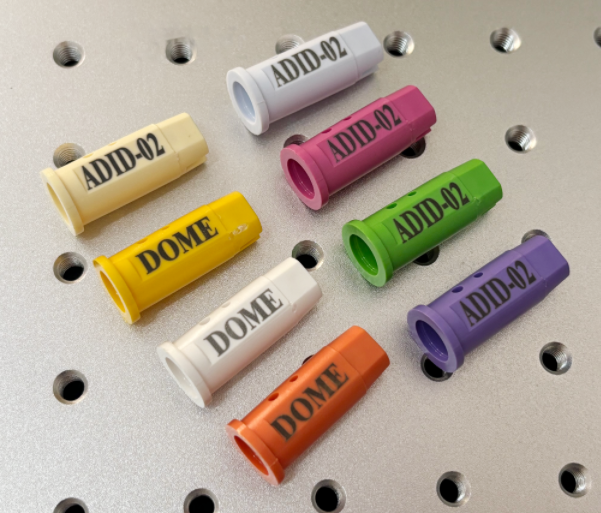
BASF’s potential acquisition of Evonik Industries—confirmed on September 25, 2026—has stalled. For most industry observers, it is just another German chemical industry headline. But for the engineers and procurement teams who specify laser marking masterbatches for livestock ear tags, auto parts, and plastic substrates such as ABS, PA, PP, PC, and PBT, it is a practical reminder: a single-source dependency upstream eventually shows up on the finished part, as contrast out of spec, certification delays, or codes that will not mark.
1.Where the negotiation stands (as of early November 2026)
· September 25, 2026 — BASF publicly confirmed exploratory talks with the RAG Foundation and Evonik Industries AG.
· Initial indicative offer — €22.15 per Evonik share, corresponding to an equity value of roughly €10.3 billion.
· Late October 2026 — BASF raised its proposal to €24.00 per share (roughly €11.2 billion) and, through CEO Markus Kamieth, pledged to rule out compulsory redundancies at Evonik through 2032.
· October 30, 2026 — Evonik’s Executive Board said it will not enter negotiations and intends to remain independent.
· Outcome — undetermined. The two sides are publicly deadlocked.

2.Why laser-marking processors should pay attention—even though neither firm sells masterbatch
Neither BASF nor Evonik sells laser-marking masterbatch under its own brand. The connection to our industry is upstream—and it matters.
2.1 Base resins and engineering plastics
BASF’s Ultramid® polyamide and Elastollan® TPU lines include laser-markable grades, and its Ultradur® PBT laser-transmission grades are used in automotive laser-welding applications. Evonik’s INFINAM® PA12 and Vestamid® polyamide lines are equally common in parts that carry laser markings. Converters serving ear-tag and automotive programs routinely spec these resins directly. A combined entity would mean fewer independent base-resin voices at the table—and a higher probability of portfolio rationalization after closing, should a deal eventually happen.
2.2 Additives and processing aids
Evonik’s AEROSIL® fumed silica, TEGOMER® dispersing and processing aids, and ACCUREL® porous carrier resins are widely used across the masterbatch and compound ecosystem. Post-merger rationalization—grade delistings, lead-time shifts, price repricing—is not unusual in such combinations, and those costs are typically absorbed first by compounders and then passed on to converters.
3.What’s this means for ear tags, automotive parts, and other plastic components
3.1.Livestock ear tags
Ear tags must stay legible for an animal’s lifetime under UV exposure, manure abrasion, and wide temperature swings. Any shift in base-resin supplier or masterbatch grade forces re-validation against ISO 11784/11785 (HDX/FDX-B RFID compatibility) and regional regulatory requirements. A qualification disruption can easily delay tag production lines that are already sized around seasonal demand peaks.

3.2 Automotive components
Laser-marked parts underpin DPM/UID traceability, permanent part numbers, and consumer-facing branding. In IATF 16949 programs, any change to formulation or resin source triggers fresh IMDS resubmission and PPAP cycles. Tight engine-bay temperature envelopes mean even a small carrier-resin change requires new heat-aging and laser-contrast testing before sign-off.
3.3 Other Plastic comonents—- ABS, PA, PP, PC, PBT ,POM
PA and PBT are where BASF and Evonik overlap directly. ABS is BASF’s own; PP and PC are not this deal’s battlefield. Either way, a resin regrade means retuning your laser — and Dome Materials’ Laser Marking Additives GW and GB ranges work across all .
4.How Dome Materials insulates your supply chain
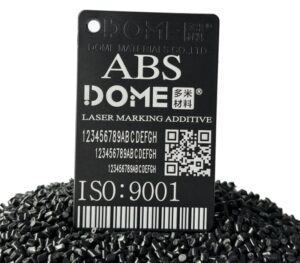
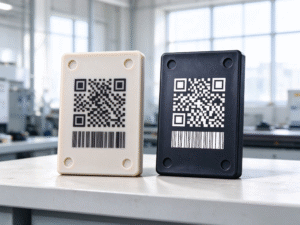
Dome Materials’ role is the laser marking additive: our Black Laser Marking on Colored Polymer and White Laser Marking on Black Polymer masterbatch ranges, which you dry-blend into whatever resin your program has already qualified. That neutrality is the point—the Dome grade works whether your base polymer comes from BASF, Evonik, or a third source.
4.1 Multi-source raw material qualification
We have qualified dual- and third-source routes for the functional additives inside our masterbatches, deliberately reducing exposure to any single European-origin input. This is a structural qualification, not a spot-market substitution—formulations are locked against qualified alternative inputs before any market shock hits.
4.2 Safety stock and lead-time visibility
We hold buffer inventory on our core GW and GB series SKUs, so a disruption in base-resin or additive markets does not immediately stop your laser line.
4.3 Accelerated sampling and joint qualification
When a converter must re-validate a laser-marking grade because their resin source changes, Dome runs expedited sample cycles and supports joint testing on your shop floor—including contrast, marking speed, and post-weathering legibility checks specific to ear tags, automotive parts, electronic device housings, and other plastic and rubber components.
Closing
Whatever happens with the BASF–Evonik talks, the takeaway for laser-marking buyers is the same: your program is only as stable as the least-qualified item in your bill of materials. Dome Laser Marking Additives is built to be the one input you never have to worry about.